Ages 5-7 (KS1)
Phonics
Writing
Maths
Spag (Spelling, punctuation and Grammar)
Reading
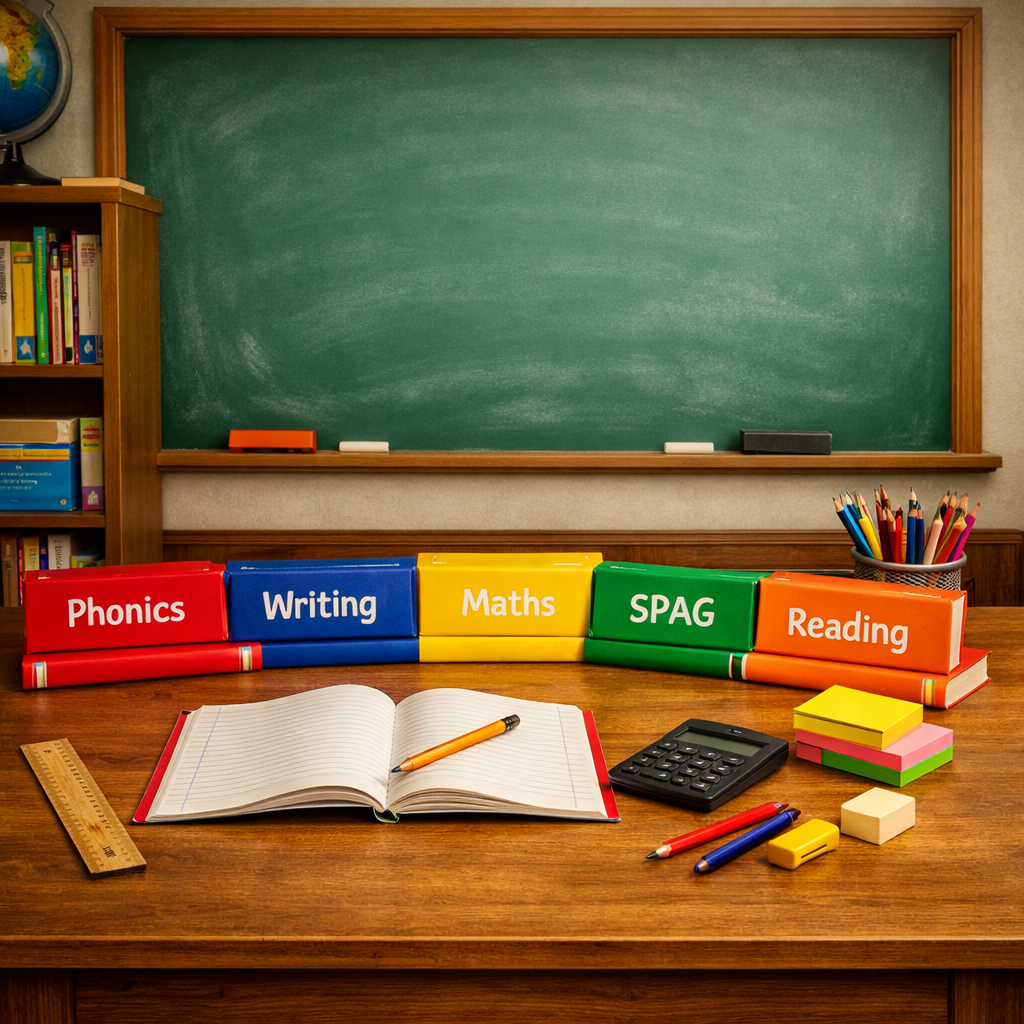
SPAG
(Spelling, punctuation and Grammar)
We teach the following to support SPAG learning in KS1.
- Spelling: Moving from Phonics to Rules
Spelling in KS1 bridges the gap between how words sound and how they are visually spelled.
- Phonetic Spelling: In Year 1, children rely heavily on their systemic synthetic phonics to segment and spell words phonetically.
- Common Exception Words: Children are explicitly taught “tricky words” (e.g., said, the, where) that do not follow standard phonic rules.
- Spelling Rules and Suffixes: In Year 2, the focus shifts toward spelling rules, including adding suffixes (e.g., -ing, -ed, -er, -est, -ful) and spelling homophones (e.g., there, their, they’re).
- Punctuation: The “Non-Negotiables”
Punctuation teaching focuses on establishing the core boundaries of a sentence.
- The Basics: The absolute priority in KS1 is ensuring children consistently use capital letters, finger spaces, and full stops.
- Expanding Punctuation: As children progress through Year 2, they are introduced to question marks (?) and exclamation marks (!).
- Apostrophes: Year 2 children learn to use apostrophes for simple omission/contraction (e.g., can’t, it’s) and singular possession (e.g., the girl’s book).
- Grammar: Sentence Structure and Word Classes
Grammar in Years 1 and 2 focuses on how sentences are built and how words function.
Year Group Key Grammar Concepts Taught
Year 1 Introduction to nouns, verbs, and adjectives; using the conjunction and to join clauses; leaving spaces between words.
Year 2 Identifying nouns, verbs, adjectives, and adverbs; using coordination (or, and, but) and subordination (when, if, that, because); understanding different sentence types (statements, questions, exclamations, and commands).